

The Preposition Trap:
Level: B1–B2 (intermediate to upper-intermediate)
Reading time: About 5 minutes
Focus: Why translating prepositions word by word can lead to mistakes—and how learning complete phrases helps.
A student once told me: “I count with you.”
I understood the message immediately: I trust you. I know you will help me.
But the English expression is “I count on you.” When we are depending on someone’s help in a particular situation, we often say “I’m counting on you.”
The student’s mistake made sense. In their native language, the equivalent expression uses a word normally translated as with. They knew the vocabulary; they had simply brought a familiar grammar pattern into English.
Let’s look at how that happens—and how you can avoid the same trap.
One meaning, different prepositions
Portuguese, Spanish, French and English can all express the idea of depending on someone. However, they do not all use the same preposition.
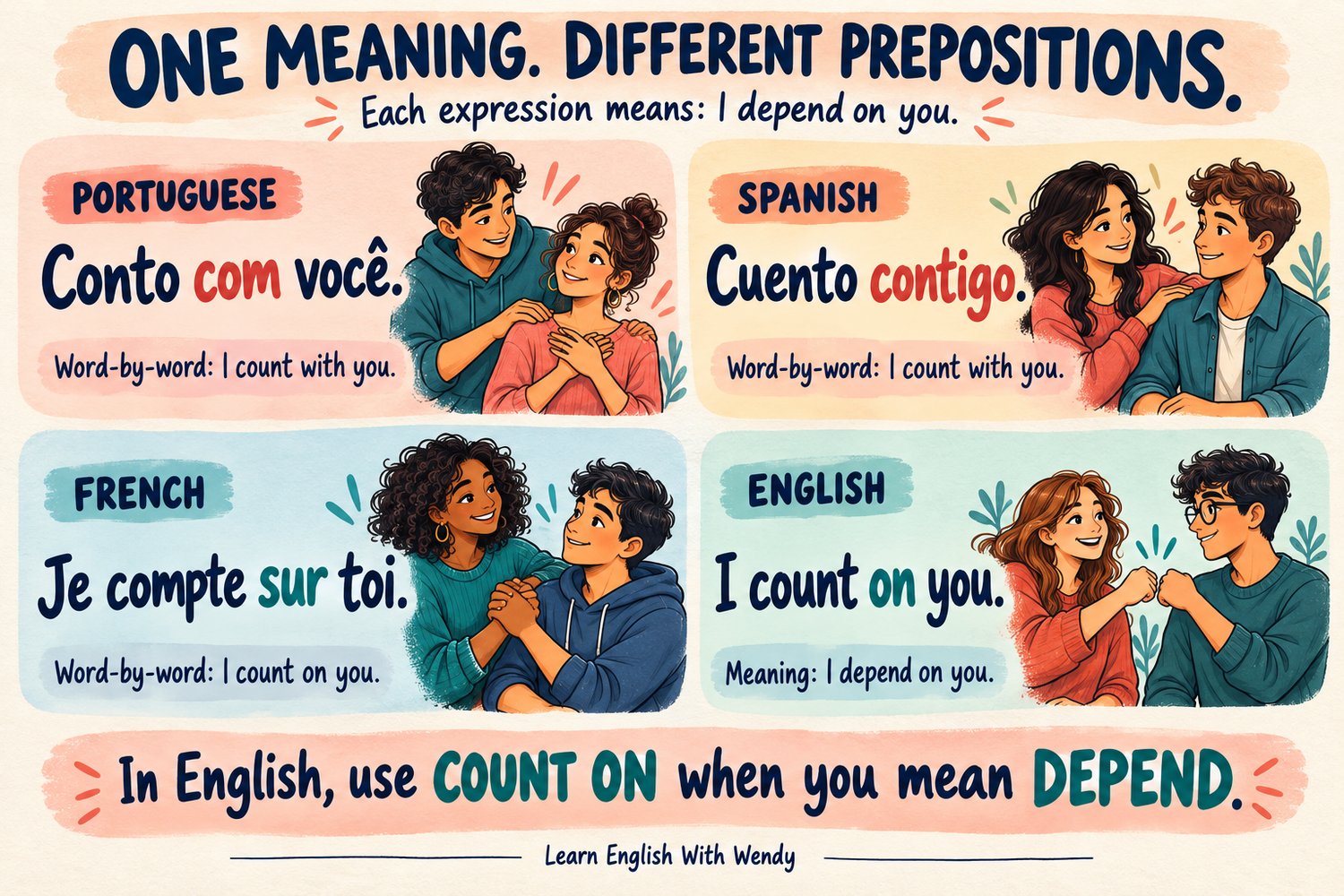
A Portuguese or Spanish speaker might therefore build an English sentence like this:
contar → count
com / con → with
The result is “I count with you.”
This is called first-language transfer, or L1 transfer: you use a pattern from your first language when speaking another language.
Sometimes that pattern helps. French compter sur matches English count on quite neatly. Sometimes it leads to an error, as with Portuguese contar com and Spanish contar con.
The important lesson is that a correct translation of each individual word does not always produce a correct translation of the expression.
Why “on” does not mean “on top of” here
Prepositions are easier to understand when they describe something physical:
The book is on the table.
You can picture the relationship between the book and the table.
But in this sentence—
I’m counting on your help.
—on expresses an abstract relationship. Nobody is physically on top of anything. The whole expression means that you are relying on someone’s help.
This is where word-by-word translation becomes unreliable. A preposition can express different relationships in different contexts, and languages do not divide those relationships in exactly the same way.
Instead of asking, “What is the English word for this preposition?”, ask:
“What English expression communicates this meaning?”
For contar com alguém or contar con alguien, that expression may be count on someone or rely on someone.
Learn the verb with its pattern
The verb count shows why learning vocabulary in complete phrases matters.
Compare these sentences:
“Please count the tickets.”
Here, count means finding the number of tickets.
“You can count on me.”
Here, count on means that you can depend on me.
“We’re counting on you to bring the tickets.”
Here, we are depending on you to do something specific.
The meaning changes, and so does the sentence pattern.
Linguists use the term valency to describe the participants and complements a verb takes. For learners, the useful idea is straightforward: learn what goes with the verb when it has a particular meaning.
For the meaning “depend,” remember:
count on + someone
You can count on Maya.
Or:
count on + someone + to do something
We’re counting on Maya to help.
That gives you a pattern you can use immediately.
A quick note about phrasal verbs
You may see count on described as a phrasal verb in a learner’s dictionary. More detailed grammar descriptions distinguish between verbs with particles, such as turn off, and verbs followed by prepositions, such as depend on.
You do not need to memorise those labels to use the expressions correctly. You do need to learn their word order.
For count on, say:
“You can count on me.”
Not:
“You can count me on.”
Treat count on as one vocabulary unit for this meaning. However, do not assume that every multi-word verb follows the same rule: turn off the light and turn the light off are both possible.
A better way to record new vocabulary
When you meet a new verb–preposition combination, write down three things:
- The complete expression
- Its meaning
- A sentence connected to your own life
For example:
Expression: count on someone
Meaning: depend on someone
My sentence: I can count on my sister when I need help.
Then practise changing the sentence:
Can I count on you?
You can count on me.
I’m counting on my sister to help tomorrow.
You are now practising a useful expression in several situations, rather than trying to remember an isolated preposition.
Use the same approach with other combinations:
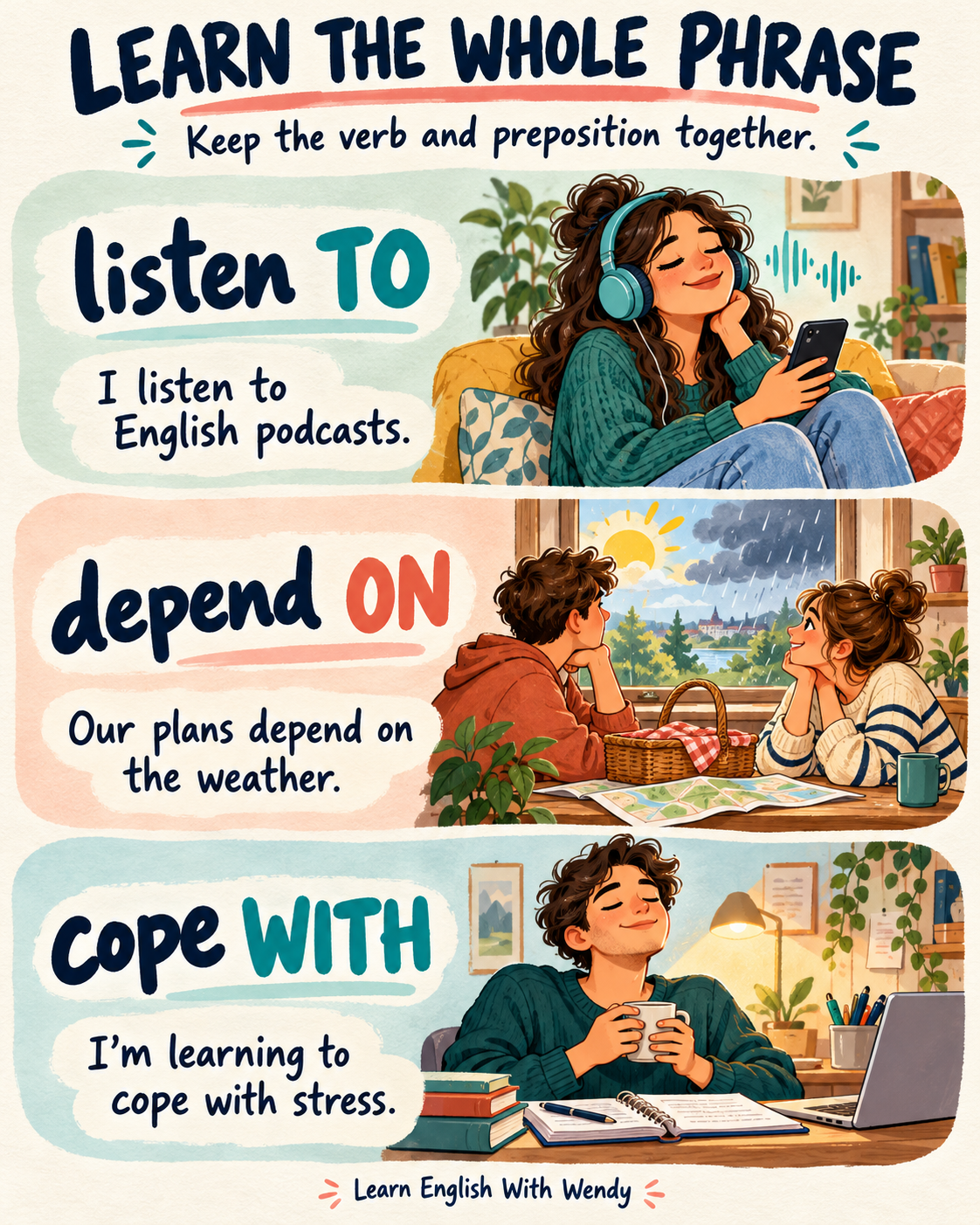
These expressions each have an established verb–preposition pattern.
Try it yourself
Complete the sentences:
- You promised to help. I’m counting ___ you.
- Please listen ___ the instructions.
- Whether we go depends ___ the weather.
Comments ()